Friday, December 20, 2019

Ford Falcon Sprint: Bodywork

The first step was to mask off the space for the (square) number roundels, as I was planning to use the base plastic white for this. Then the rest got painted Tamiya TS7, Racing White, which is kind of off-white.


Next step was a quick check of the stance, which showed it to be too high in front. (Tape remained because there is a blue stripe that also needs to go in). Some surgery to the subframe followed to get it sitting lower by a mm or two.


It's still high but period pictures show lots of ground clearance which makes sense on a rally car.


Next was lots of tape to allow the blue stripe (Tamiya TS23 Light Blue) up the side. A bit of seepage under the tape, and some spots where I covered up too much with the tape, will need to be looked at. As well the pure white number roundel may need pure white paint -- the plastic is not quite right. Finally silver trim will go on, probably with a pen, and probably with tape as a guide. To be decided while the blue sets.


Decals need to be made next.


Stay tuned! I might actually get this done by the end of the year.

Wednesday, December 18, 2019

Ford Falcon Sprint: chassis and interior

The engine is in the chassis, and the front subframe is attached to the floor pan.


The level of wiring and piping was challenging but I am getting better at it. Practice, practice, practice.


The oil cooler on the left front corner of the engine compartment is a photo-etched piece from Scale Production in Germany.


Period photos show a range of added gauges in the middle of the dashboard, ranging from a row of auxiliary gauges to a large clock for the copilot. I went for three large gauges, and have skipped making a Halda Speedpilot.


Seats were stolen out of an AMT Cobra which I built a number of decades ago, and which suffers from a number of flaws, both inherent in the kit and those arising from my skill level at the time. The kit included styrene seatbelts. Seats had to be raised slightly compared to the Cobra.


Next is white paint and a blue strip along the side. The paint will be slightly off-white (Tamiya TS 7) and I have taped off the square number pad which will simply be covered in gloss coat.


Stay tuned!

Friday, December 13, 2019

Ford Falcon Sprint: engine

The 289 for the Monte Carlo outing was prepped by Holman & Moody and included a pair of carbs and an oil cooler.


The engine compartment on the Falcon was pretty narrow due to the spring and shock assembly sitting on top of the upper A-arm; bigger Fords had the coils behind the steering knuckle and leaning on the lower A-arm, leaving much more room in the engine compartment for big block motors.

The carbs in the kit may or may not be Carters as in the original; I'm not up on my American carbs.


The oil cooler is a photo-etched part from Scale Production in Germany. The only item missing is a coil.


Overall I'm quite happy with the result. This includes a bit more wiring than I usually do, including a wire from the positive battery terminal to the starter motor which is, of course, completely hidden inside the shock towers and under the exhaust manifold on the right side.

The Trumpeter kit includes a fairly flexible front subframe which is hopefully going to line up properly. So that's all done and the interior is the next step.

Monday, December 9, 2019

Ford Falcon Sprint: Monte Carlo "winner"

The record books will go on at great lengths about the 1964 Monte Carlo win by the Mini driven by Paddy Hopkirk and Harry Liddon. I will admit that the win was certainly well deserved, but the reality is that a Ford Falcon Futura Sprint, with a Holman and Moody 289 driven by Bo Ljungfeldt and Fergus Sager, won or tied every single stage, a record which, as far as a quick Google search can ascertain, has not been repeated since. The Mini, which came in 17 seconds behind the Falcon in overall time, won due to handicap rules that favoured smaller engines combined with a win around the Monte street course where it was better suited than the 305 hp Ford.


So when I came across the Trumpeter kit, I thought it would be interesting to build up a replica of the "winning" Falcon, shown below with Tamiya's 1967 Monte-winning Mini. (I also intend to build up a replica of Gentleman Jack Sears' 427 Galaxie that terrorised British saloon car racing at about the same time, but that's a story for another day).


Trumpeter is not well known to car modelers, having produced little beyond a series of '64 Falcon variants (Ranchero, convertible, Sprint).


The kit is very well detailed, with the belt drives (for instance) consisting of two pulleys and two belts. The quality of the molds is excellent and it is sad that Trumpeter, which produced the excellent MAZ 537 at 1/35 described elsewhere in this blog, has not seen fit to produce more automotive kits.


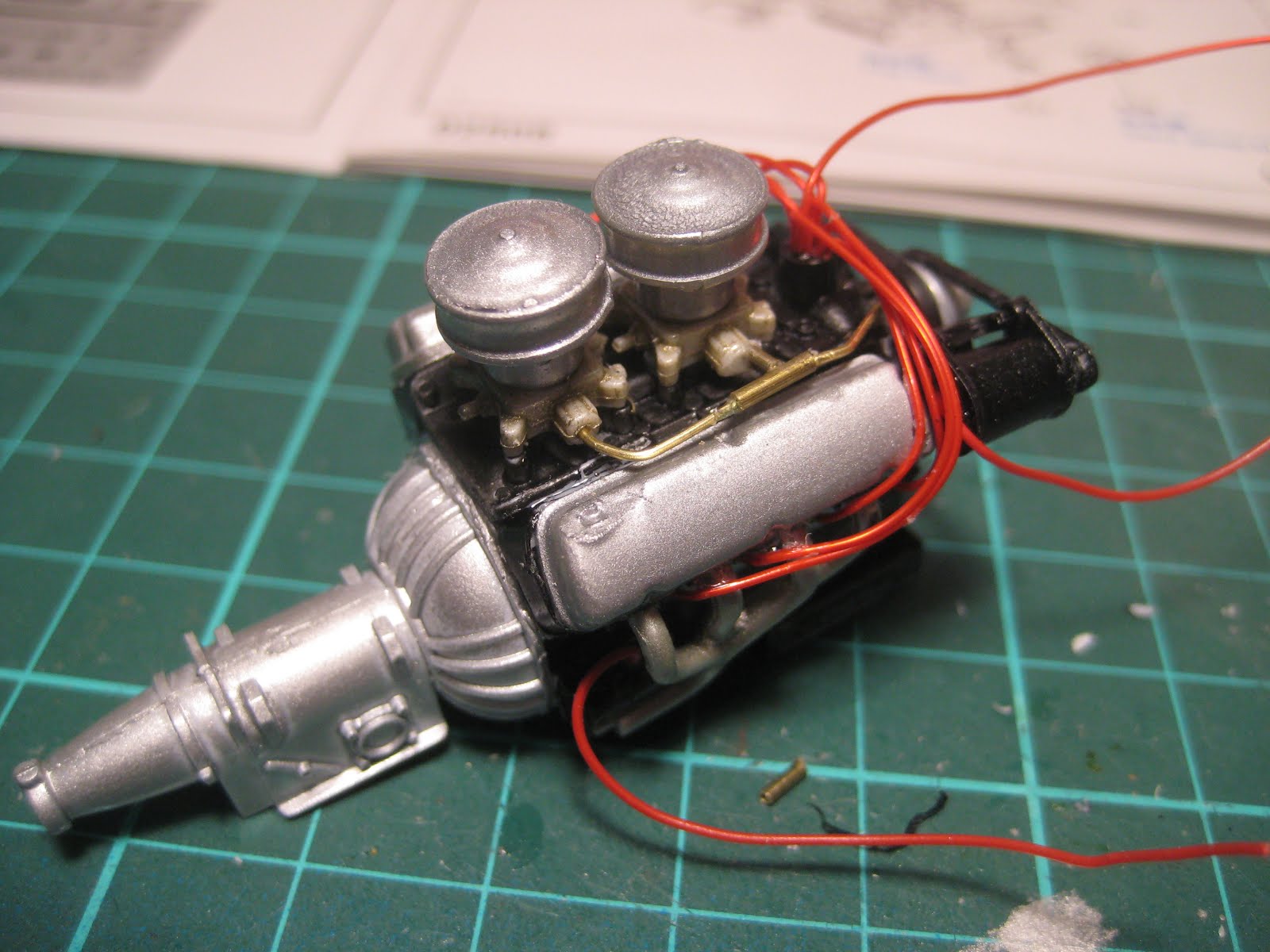
The engine in the kit comes with an assortment of options, including Cobra valve covers and oil pan, and a fuel injection setup. Period photos show plain stamped valve covers and a pair of Carter carbs, as well as a big oil cooler that I will scratch build.
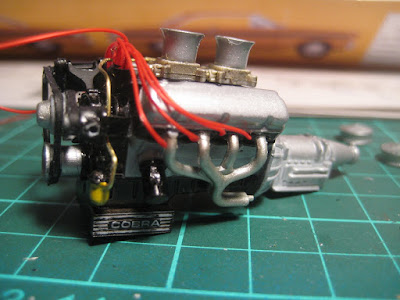


I used an aftermarket distributor. The fuel line is made of 0.5 mm brass rod (which is actually big, at 1/2" at scale). The starter motor and generator also have red wires which is, admittedly, a bit confusing.


All looking pretty good so far. Air filters are a shame but are period correct.


The Falcon is still running today and must be a rip-roaring riot climbing up out of Monte Carlo, a twisty climb for which it is poorly suited as attested by the tail-out attitude in the photo below.


Stay tuned! This could be fun.

Sunday, December 8, 2019

Lotus Eleven: Complete (#13 for 2019)

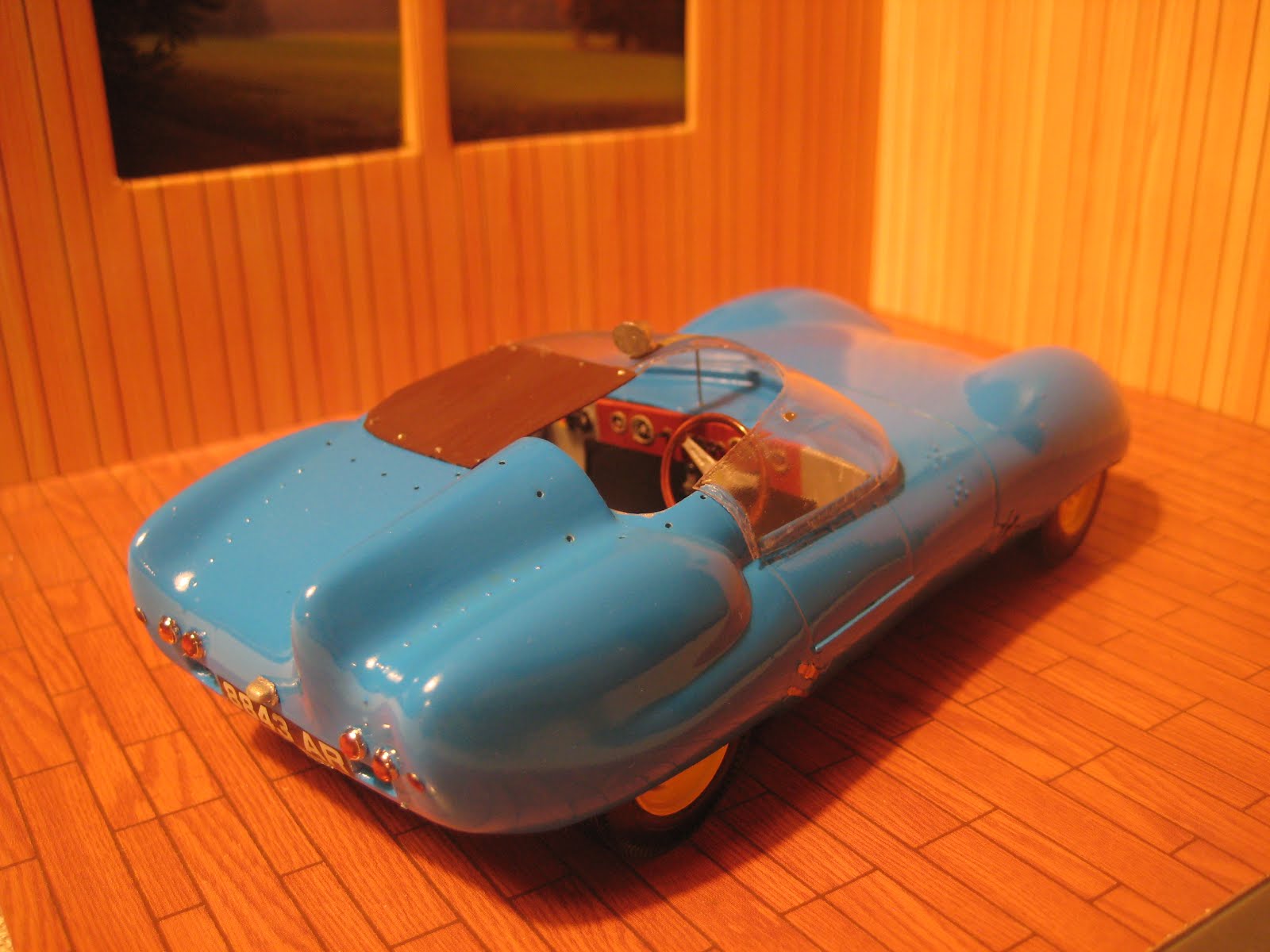
Finally another one done! The Lotus Seven/Eleven is complete.


Dashboard and cockpit detail includes the regulator for the generator.


It may be meant to reproduce a road car, but I kept the Le Mans windshield and tonneau cover provided in the Profil 24 kit.


The fabricated hood hinge uses brass tubes inserted one inside the other.


Intake horns are longer ones from Scale Productions, and are bordering on too big for this set of Webers.


The full Lotus complement. Seven and Eleven have the same license number plate, something I should probably fix... The Elan chassis is complete but the body is not; the Europa is an older build.


So what's next? Perhaps there is another WIP that's close. Stay tuned!

Friday, December 6, 2019

Lotus Eleven: final assembly has begun

So I am taking a break from the De Havilland Mosquito (two-seater, with twin Rolls Royce Merlins, 27 litres each and a combined 2900 horsepower) to finish up the Lotus Eleven, coincidentally also a two-seater, but with a Lotus-modified Ford Cortina engine, 1430 cc, maybe 110 hp, 115 tops. Ringy dingy ding.


So this isn't really an Eleven, as I have matched the Profil 24 Eleven resin slot car body to Tamiya's Seven chassis and mechanical bits. The Eleven never had the hot-rodded Cortina engine, or the double A-arm front end, or the solid rear axle. A Seven Eleven, maybe? 


So anyway I decided not to deck it out in 1957 Le Mans livery (British Racing Green with a thin yellow stripe down each side) as it is not a Le Mans racer. That left me room to be creative with the colours. 


Work in Progress but I am getting there. I particularly like this angle. What a basic little ride!


Stay tuned!

Mosquito: modified build sequence


For anyone considering tackling the Airfix 1/24 Mosquito: After carefully pondering the 56-page instruction book, I decided to change the assembly order, mainly because Step 5 involves a structure that will be easily damaged. Here is the order I built it in (numbers refer to the Airfix assembly step): 

1-4, 
6-8, 
9 (except part 37L), 
11 (except part 39L), 
12-15, 
17-24, 
16, 
25-27, 
10 (including parts 37L and 39L), 
5, 
28-33, 
35-37, 
34, 
38-42. 


For Steps 42 to 143 I have followed sequence in the instructions; I am presently stopped at 144 but have done 220-225. So far this has worked out, and there were no points where I realised afterwards that changing the order was a mistake. 


Stay tuned! Progress is being made.