Wednesday, June 16, 2021

Ferrari 315 S: Chassis Part 2

The last post should have said suspension, because there are a lot of other bits to the chassis. 


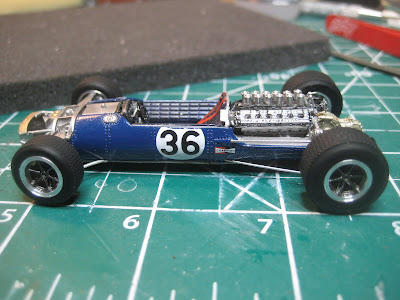
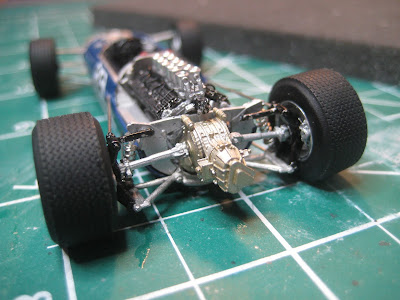
The wheels are apparently made via laser lithography, and are very delicate but very nice. Here they are just inserted for test shots.Paint consisted of AS-12 Bare-Metal Silver with TS-30 Silver leaf on top. 

I added a few bits of tube here and there, for instance to the oil filter on the left side inner fender. One of these days I'll sort out the Detail Master braided lines, which still tend to fray in my hands. A link from the throttle pedal to the carbs on the engine is on the list.

The four ignition coils stick through the firewall into the cockpit. The kit also includes a panel full of relays with the possibility of full wiring, but I decided that this would be a lot of work at 1/24.

The main part of the dashboard is molded with the body and will come later. The enormous gas tank unfortunately hides the de Dion rear suspension.

So it's moving right along; next will be the scary part, which is putting paint on the body. Wish me luck! 


Monday, June 14, 2021

Ferrari 315S: Chassis

The chassis is complete and illustrates typical Ferrari approaches in the mid to late '50s. 


Coil springs and A-arms up front, with friction shock absorbers and a worm and sector steering box are state of the art for the time. 


The chassis, consisting of a couple of big tubes and some smaller triangulated segments, is also state of the art for 1957, although Jaguar's leading-edge monocoque was introduced in the 1954 D-Type. 


Of course the 4-cam V12, with the big-bore design and lots and lots of Webers, was not just state of the art but leading edge. The Maserati 450 S was faster by the simple expedient of enjoying another three-quarters of a litre displacement over the 315S, but the 3.8 litre Jaguars, with a prewar long-stroke design, couldn't keep up.

The rear-mounted gearbox, de Dion tube and friction shocks were all common to Ferrari and its competitors. Not shown here are the 4 monster drum brakes, an area where the British cars, with disk brakes taken from aircraft applications, were well ahead.


The 1957 Mille Miglia was sadly marred by one of the all-too-common accidents in '50s road racing, killing de Portago and his navigator in a 335S, along with ten spectators; the Italian government banned road racing three days later, and the sports car racing rules had a new 3-litre limit for 1958. Arguably with Ferrari's 3.8 and 4.0 litre motors no longer eligible, this paved the way for two more British wins at Le Mans due to Enzo's reluctance to give up his drum brakes. 

On to the interior and firewall. Sadly the entire rear suspension will be hidden under the mammoth gas tank. 


I'll leave you with this tantalizing test fit of the body over the chassis, which looks good at this point. Love those '50s sports racer curves. Stay tuned!

Tuesday, June 8, 2021

Ferrari 315S: First steps

After a period of futzing around with a lot of WIPS and getting nowhere, I pulled this kit off the shelf and got started. 

Desperate to keep up with the 4.5 litre Maserati 450S in 1957, Ferrari got to work on expanding the 3.5 litre 290 MM, first to 3.8 litres (315 S), then to 4 litres (335 S). The engines were 4 cam units with twin plugs per cylinder. Sadly Alfonso de Portago crashed his 335 S in the Mille Miglia, killing himself, his navigator and 10 spectators; as a result, this was the last Mille Miglia, and the sports car rules for 1958 limited displacement to 3 litres. 

None of the other 4 litre cars did well in 1957; but Piero Taruffi won the Mille Miglia in a 315 S, with Wolfgang von Trips second in another 315 S. Maserati entered a couple of 350S models, neither of which finished; Jean Behra crashed his 450S in practice and didn't start. (I have an unbuilt kit of the 450S which didn't finish at Le Mans, from Profil 24).

The Model Factory Hiro kit is one of the newer ones from MFH and is thus particularly well detailed. This is the 1/24 scale kit, but is also available in 1/12 at huge cost. 


First step as always was to soak resin parts in isopropyl alcohol. Locally it has been possible to find this at 99%, but other jurisdictions limit it to 91%. (The 70% concentration isn't really effective). White metal parts get an acetone bath. All parts were then washed in Dawn dish soap in warm water (hot water for white metal).


The engine includes spark plugs (24 white metal parts, painted red in the photos) and throttle linkages (9 photoetched pieces and a length of 0.4 mm nickel steel wire). Needless to say this all required the 4X desk magnifier. Carbs are done, next is distributors and wiring looms.


As the list of Works In Progress is large and growing, I need to finish something soon... not sure if this will be the one, but things are moving ahead nicely. Stay tuned!

Sunday, May 16, 2021

Jaguar Mark II 3.8: Complete (#8 for 2021)

An excellent kit by Tamiya, and decent build, but not one of my better ones. 


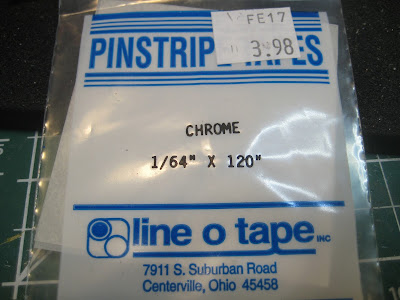
There are lots of last minute glue smears on the body, and the metal transfers were a major issue which I partly fixed using this chrome tape I picked up somewhere or other.

 
The photos highlight another problem, which is an inordinate amount of dust that seems to want to stick to the paint. Not sure how to fix this without further disturbing the metal transfers.


Perhaps one day I'll buy another one of these and do it right. Meanwhile it's time to move on. Stay tuned!

Mosquito: Rescue from the Shelf of Doom

Well, I knew life was short, but I guess we forget... Raimo Leino, the admin of one of the more interesting scale modeling Facebook groups, died suddenly a week ago of a heart attack. He was retired from the Finnish air force, but he certainly wasn't "old"... As the group he founded (Oldies and Goldies Scale Models) featured mainly aircraft builders, I guess my memorial will be to get back to the 1/24 scale de Havilland Mosquito I started about 3 years ago. (My last post on this was December 2019). 

After the war, the Canadian aerial survey company Spartan Air Services bought several Mossies and flew them all around the world. (Although they sadly no longer fly Mossies, the company still exists under the name Sanders Geophysics, located at the international airport in Ottawa). The plan is to reproduce this civilian application. 

The first challenge will be the decals for CF-HMS, which are no longer available from canmilair.com. Most of the text and straight lines can be reproduced; and I have uncovered the Calgary Mosquito Society which is rebuilding CF-HMS to see if they have some additional image files, such as the Spartan Air Services logo (yellow triangle with a blue wing) in higher resolution that I might be able to print. 


The second challenge will be casting a clear nose cone... this will be an opportunity to get off my duff and work on the necessary techniques. Apart from that I need to complete the second of two engine and landing gear nacelles, and scan through the instruction book for remaining work needed.

Stay tuned!

Monday, May 10, 2021

Jaguar Mark II 3.8: Interior

After a month of focus on Dan Gurney's 1/43 Eagle Weslake, I've decided to go back to something a little easier for a break. The Jag has been on hold for over a month now.

The paint needed a bit of fixing; and the metal transfer pieces were in some cases replaced with a 1/64" chrome tape I had lying around. 

Inside, the decals for the wood dashboard went on particularly well. 


Final assembly looms large. Stay tuned!

Friday, May 7, 2021

Eagle Weslake: Chassis progress II

The rate of progress has been in the molasses range as I am finding it hard to get motivated. Maybe it's time to put it aside for a while... first an update. 


Lordy but these bits are small! Hubs consist of two cast pieces, sandwiching discs made of two pieces of  photoetched sheet, and a cast caliper.


Plumbing is complete, including the pipes running under the monocoque, with the exception of a microscopic bit of pipe which no one will ever notice.


Front and rear suspensions are also complete, and the car sits square on its 4 wheels. 


Exhaust pipes will be the next challenge, with the pipe tie-down clamps being both minuscule and flimsy. 


Still it will be nice to see it taking its place on the podium next to the second-place BRM. 


Stay tuned! One way or another, I'll have something to report in the not too distant future.