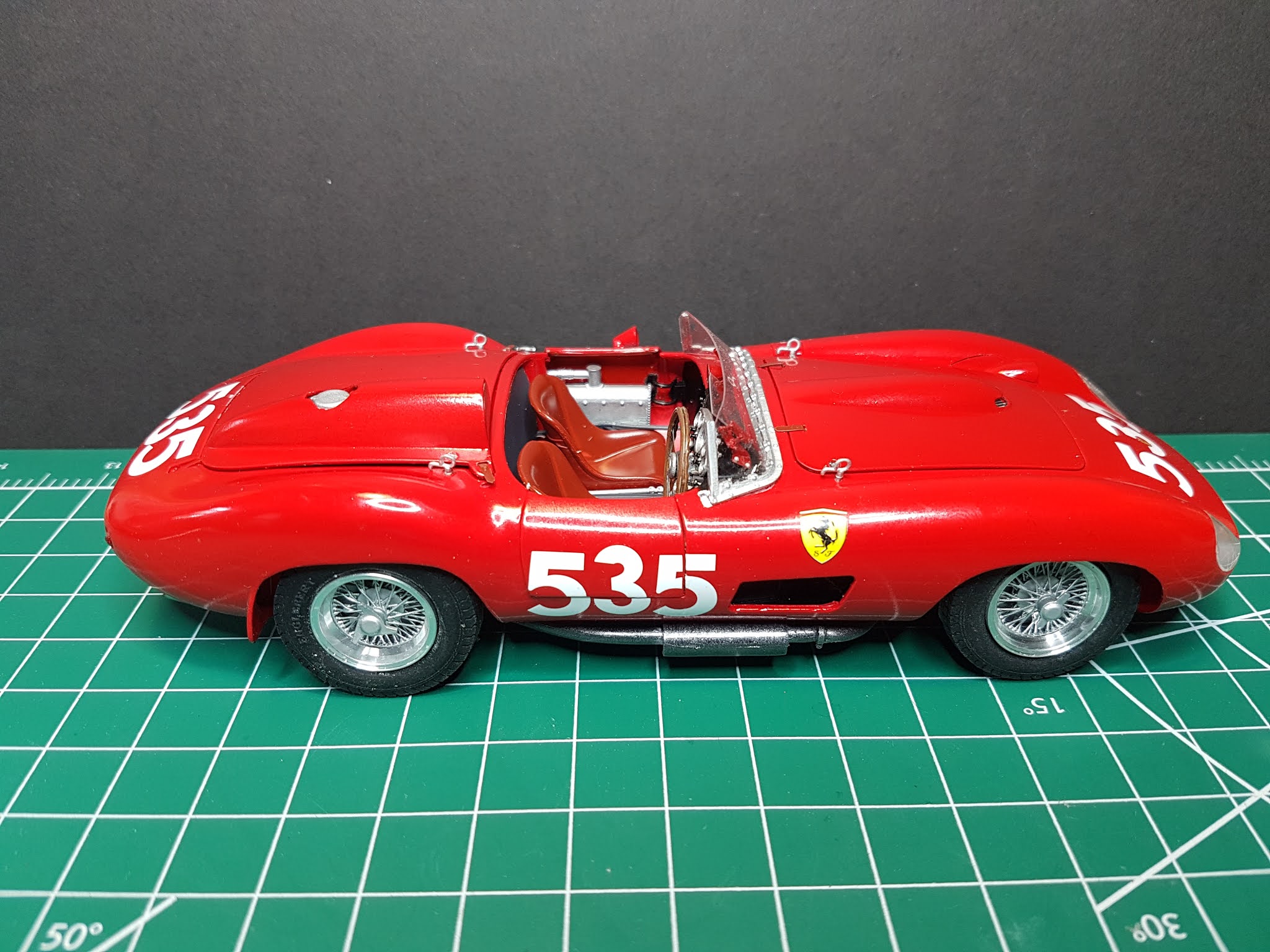
Finally done! Boy do I hate vacuum formed windows. Otherwise a decent kit and well worth the effort, even if I would prefer the road version without the little fender lips. A muscular shape with lots of muscle under the hood.


Stay tuned!
Finally done! Boy do I hate vacuum formed windows. Otherwise a decent kit and well worth the effort, even if I would prefer the road version without the little fender lips. A muscular shape with lots of muscle under the hood.
The engine is in, the drivetrain complete, the lovely photo-etched wheels are complete, and it all sits nice and square at a proper ride height.


When I first saw pictures of this car as a pimply teenager, it was lust at first sight. Still beautiful after all these years...

This Model Factory Hiro kit is definitely a Holy Grail kit, and it's been on the shelf for a good long while, waiting for me to gather the confidence to build it without screwing up. However, having done well on the 315 S and the Alfa Stradale, I think it's time; and it certainly looks like an easier build than either of those.

This early Model Factory Hiro kit (K123) is likely a re-release of the old Climax kit. It has bigger rear fender openings and a crude fender lip, compared to my mental image of this car. These interfere with the lines in my view; but a little digging revealed that several (perhaps 4) of the original 19 cars were built specifically for racing, and included a lower roof line as well as the prominent rear fenders and a pointier nose. This particular car DNFed at Le Mans in 1961 (battery failure at 24 hours, sadly! On distance covered, the car would have been 9th, ahead of a Triumph TR4S) and ran in the Japanese GP in 1963 (for which I can't find any info online). So I have reluctantly decided to build it out of box, rather than try to reproduce the "street" version.

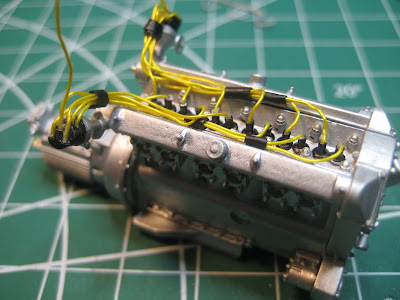
Stay tuned!
Lots of finicky little detail but it all went together well in the end.


The grille has slots to take the vertical bars, which meant I didn't need to make a jig as with older Model Factory Hiro kits of Ferraris.


A lovely '50s shape.


Not sure what's next! Stay tuned.
The last post should have said suspension, because there are a lot of other bits to the chassis.


I added a few bits of tube here and there, for instance to the oil filter on the left side inner fender. One of these days I'll sort out the Detail Master braided lines, which still tend to fray in my hands. A link from the throttle pedal to the carbs on the engine is on the list.

The four ignition coils stick through the firewall into the cockpit. The kit also includes a panel full of relays with the possibility of full wiring, but I decided that this would be a lot of work at 1/24.

The main part of the dashboard is molded with the body and will come later. The enormous gas tank unfortunately hides the de Dion rear suspension.

So it's moving right along; next will be the scary part, which is putting paint on the body. Wish me luck!
The chassis is complete and illustrates typical Ferrari approaches in the mid to late '50s.


The rear-mounted gearbox, de Dion tube and friction shocks were all common to Ferrari and its competitors. Not shown here are the 4 monster drum brakes, an area where the British cars, with disk brakes taken from aircraft applications, were well ahead.

On to the interior and firewall. Sadly the entire rear suspension will be hidden under the mammoth gas tank.

I'll leave you with this tantalizing test fit of the body over the chassis, which looks good at this point. Love those '50s sports racer curves. Stay tuned!
After a period of futzing around with a lot of WIPS and getting nowhere, I pulled this kit off the shelf and got started.
Desperate to keep up with the 4.5 litre Maserati 450S in 1957, Ferrari got to work on expanding the 3.5 litre 290 MM, first to 3.8 litres (315 S), then to 4 litres (335 S). The engines were 4 cam units with twin plugs per cylinder. Sadly Alfonso de Portago crashed his 335 S in the Mille Miglia, killing himself, his navigator and 10 spectators; as a result, this was the last Mille Miglia, and the sports car rules for 1958 limited displacement to 3 litres.

None of the other 4 litre cars did well in 1957; but Piero Taruffi won the Mille Miglia in a 315 S, with Wolfgang von Trips second in another 315 S. Maserati entered a couple of 350S models, neither of which finished; Jean Behra crashed his 450S in practice and didn't start. (I have an unbuilt kit of the 450S which didn't finish at Le Mans, from Profil 24).
The Model Factory Hiro kit is one of the newer ones from MFH and is thus particularly well detailed. This is the 1/24 scale kit, but is also available in 1/12 at huge cost.


As the list of Works In Progress is large and growing, I need to finish something soon... not sure if this will be the one, but things are moving ahead nicely. Stay tuned!
