Sunday, April 25, 2021

Eagle-Weslake: Chassis progress

This is moving slowly as the bits are very small and getting it all to line up is challenging. The engine is in, and as straight as possible.

Body panels are painted (Tamiya TS-15 Blue) but may need some touchups. The side panels go on fairly early in the build process and the possibility of a chip is high. Here they are simply mocked up.


Piping, radiators and various reservoirs are also in place in the front. 


An ongoing challenge. Stay tuned!

Friday, April 16, 2021

Eagle-Weslake: Background and first steps

The 1967 Belgian Grand Prix was unusual for a couple of reasons. The much-maligned BRM P83 with the H16 motor scored its best finish, with Jackie Stewart taking second place, and Dan Gurney scored the only win of the Eagle-Weslake. (To be fair, Jim Clark won the US GP in an H16-powered Lotus in 1966.) 


Having built the H16 in 1/43 scale, now it's time to move on to the Eagle; and in time I'll build the Ferrari 312 driven to third place by Chris Amon to complete the podium.


 Of course this is a 1/43 scale Model Factory Hiro kit, so expect challenges! 


Present status is the baggies have all been opened, the parts inventoried with only a few unidentified objects, and everything has been dipped in acetone for a few minutes, then washed in hot water and a bit of Dawn soap.

Engine assembly is progressing, illustrated here with my attempt to put in 0.012" Detail Master wire for the spark plugs. Of course 0.012" works out to over half an inch diameter at full scale, but this is about as fine as you can get. And of course I won't be drilling out the distributors, which are way too small, but I'll simply tuck the wires in behind the chain cover where no one will see them. (Please don't tell anyone).


Body panels have been painted. Tamiya TS-51, Racing Blue, looks too dark and the current paint is TS-15 Blue. Some polishing will be needed and possibly additional coats of paint.


Stay tuned!

Elimination of e-mail notification system

Google, which supports this blog, tells me that after July 2021, my feed will still continue to work, but the automated emails to subscribers (if any) to let you know that there has been a new post will no longer be supported.

If you have signed up to be alerted of new posts and would like to continue getting these alerts, please drop me a comment. I won't post your comment but perhaps we can work out an approach to this. One option, of course, is to move the blog to another platform, but this is a last resort in my view.  

In the meantime there is a new Subscription button, we'll see how that works.

Tuesday, March 30, 2021

Jaguar Mark II 3.8: Overview and paint

As a one-time owner of a Rover 2000 TC, known to some as 'the poor man's Jag', I secretly lusted after a Mark II, although I would never have admitted it at the time. I also had the opportunity of working on Rovers (mine as well as customers') and Jags, and concluded that at best, the Jag was no more reliable than the Rover. Perhaps the Rover's use of a mechanical fuel pump put it marginally ahead of the Jag, which relied on a pair of the dreaded S.U. electric pumps; both used the same S.U. HS8 2" carbs, Lucas electrics and Smiths gauges and heater fans. 


Tamiya's kit is absolutely superb, even coming with a sheet of dark red felt for the carpet, and I began assembling it completely stock after concluding that the V12 from the XJ-S really wouldn't fit. (That would be a project for the whale-like Mark X, in my view, which would make it a Mark XII. But I digress.) 


The body is done, with the exception of a couple of bubbles low on the trunk lid that will need some sanding and respraying. I'll probably dribble a bit more panel line down the seams as the paint refused to flow into these grooves adequately.


The callout for body colour is a bit odd: Instructions call for "TS-43, British Racing Green"; but my can of TS-43 clearly says Racing Green, and to my eyes is a bit light. TS-9, British Green, is darker and in my view closer to the correct colour, although to be fair the Rover was Willow Green, a couple of shades darker than the classic BRG. And I checked the Tamiya website: there doesn't appear to be a "British Racing Green" in Tamiya's colour chips.

The interior colours for leather are very nice, with the leather a 50:50 mix of flat and gloss reds (XF-7 and X-7 respectively), and carpeted sections 4 parts flat red cut with 1 part smoke (X-19).


Stay tuned! Yes, yes, I'll get back to the 917K eventually.

Saturday, March 27, 2021

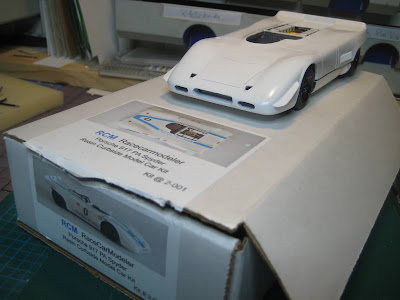
Porsche 917 PA: Complete (#7 for 2021)

Some of you may remember Allen James and his website www.racecarmodeler.com. Allen passed away some time ago; and I dug out this resin kit he made to build in his memory. 


The 917 PA was a lightened and roofless 917 K, with bodywork resembling the earlier 908/02 and 908/03. In spite of turning up at the 1969 Can-Am at mid-season, Jo Siffert did well against the much bigger 7-litre McLarens in spite of a 2.5 litre disadvantage. Of course the later turbocharged 917/20 and 917/30 quickly dominated the Can-Am in future seasons. 


I am particularly fond of this car because of the very clean shape. The kit is a good one, for a simple resin body, but the decals crumbled; fortunately I had thought to scan them prior to cutting them up and was able to print a copy, although not at as high a resolution as I would have liked. I still need to touch up the decals once it's all completely set, then coat with clear.


At the time of his passing, Allen was working on a resin kit of the C-Type Jaguar that would have used the Revell XK-SS as a donor; I am not sure what happened to those moulds. Of course the Revell XK-SS is not exactly common any more either...

Monday, March 15, 2021

VW 928 Scirocco: Background

Needing a break from the 917K, I looked around the stash and found, side by side in the German road car section, AMT's Scirocco and a tarted-up 928 Targa from Revell, both in 1:25 scale. 

Then I recalled the article in Road & Track back in 1979, describing a Golf with 928 chassis (click here), and I figured what's sauce for the Golf is sauce for the Scirocco. So out came the saws! 

Fortunately the 928 featured a transaxle so there will be very little need for a transmission hump in the cockpit, and the general layout looks fine. But the stance will need to be looked at, as it is sitting way too high.  


The 1:1 Nordstadt Golf was actually widened by 9" to fit over the 928 chassis, but that requires widening the windshield as well, which was identified in the article as a major expense. So I've decided to cram as much under the Scirocco skin as possible, and deal with the tires by means of flares. The Scirocco kit actually comes with a set of really ugly ones, so we'll see once the chassis is built up and inserted into the body.

Sunday, March 14, 2021

Porsche 917K (MFH): Chassis I

I am now remembering what the problem was with the 908/03: All those flexible little white metal bits making up the tube frame. The minuscule dowel and socket joints, with next to no surface area for the glue to grab on to; the fact nothing lines up without a lot of careful bending, filing, drilling and cussing; the fact the weight of the engine (which in the 917K has 50% more cylinders) puts a huge load on all the joints and keeps pulling them apart... These kits have to be the most difficult MFH kits, period.


And don't get me started on the heat sinks for the little relays attached to the bulkhead! Each consists of a white metal relay, a photo-etched baseplate that bends up to form the outermost cooling fins, and 4 more actual fins. It took me a couple of hous to come up with an assembly routine that worked.


So anyway will this be a better build than the 908/03? I certainly hope so, but I'm not holding out too much hope. Meanwhile I might need a break (again) to get back in to the Zen mode that these kits demand.


But that said, the engine sure looks good inside that frame! Stay tuned!