Speaking of Japanese kits, it seems that Fujimi is re-releasing the gorgeous 330 P4, if my favourite Japanese site is correct. I've ordered one, and have also contacted Strada Sports to see if they can get the Historic Racing Miniatures resin version of the motor for this car.
I'll look around for decals; the model supposedly reproduces the 3rd place finisher at Daytona in 1967, but the decal set doesn't list drivers.
Order here or through your favourite retailer: http://www.1999.co.jp/eng/10230990 .
Wednesday, March 2, 2016

Tuesday, March 1, 2016
The Japanese are coming, Part 2
Looking back, I can see the Japanese focus has been increasing lately: the Honda Civic racer that I built to see if I could actually get something (anything) done in a weekend; three Skylines so far; the current BRE Datsuns. Many of these are currently displayed in the trailer portion of a Mitsubishi Fuso car carrier. I'm not counting the Nissan R90V, Mazda 787B and Honda RA272 that go back a few years, and I probably shouldn't mention the NSX and Dodge Stealth (née Mitsubishi 3000) with blown Ford 427s shoehorned into the engine compartment, the 1982 Prelude with a Chevy Blazer V6 in the back seat, or the chopped and sectioned Suzuki Samurai with a Dodge Stealth twin-turbo V6 also in the back seat. At least the Dodge motor in the Suzuki is actually a Mitsubishi 3000 unit, not a big lump of Yankee iron.
In the unstarted pile, there is a 1996 Toyota Twincam Turbo Group B rally car, a Toyota TS-One Le Mans car, a Fairlady 432R (a 2-litre, twincam version of the 240Z), an RX7, a pair of tiny little Hondas (S600 and S800), two kits of the Mitsubishi Delica Star Wagon 4WD Super Exceed which I've set aside for kitbashing, and a Suzuki Carry ST30 light (very light) commercial vehicle.
Twenty-two distinct vehicles in all. And to top it off I ordered a few more items from my favourite Japanese purveyor of styrene kits, Hobby Search (click here), bringing the total to 26.
First is what was sold in North America as the Toyota Corolla from 1983 to 1987. The last rear drive Corolla, this Aoshima kit has a very well detailed twincam, fuel-injected four which duplicates the car seen in a popular Japanese Manga comic. (I found out about the Manga comic after I got the kit). You'll find it on Wikipedia by looking for Toyota AE86.

The Subaru Sambar is the opposite. The Japanese kei car (literally light car) category benefits from reduced taxation but has to fit within fairly strict guidelines as to outside dimensions and engine size. The Sambar is apparently a well-loved little commercial vehicle, a bit like the split-window VW van; in fact you can find pictures of Sambar vans made up to look like shrunken VWs. I picked up this pickup version in part for technical reasons; the 660 cc, water-cooled triple is lying flat under the back, driving all four wheels. A real little oddball. Both this and the AE86 are well-detailed Aoshima kits. I have often wondered, on coming across a particularly oddball Aoshima or Fujimi kit, whether it was curbside or not; the Japanese website listed above provides images of instruction sheets online, so you can tell before you buy just how much detail you are getting.

Continuing my current obsession with Skylines, I ordered two as described at the end of the post here: http://24th-scale.blogspot.ca/2016/02/skyline-update.html
The original Skyline wasn't even a Nissan, it was a Prince, which was in the process of being bought out by Nissan when the first Skyline came out. The Fujimi curbside kit of this, known by the factory designation 54A (moderate state of tune) or 54B (hairier state of tune), shows a fairly ugly little car, typical of Japanese 'design' of the mid-60s. I'll probably replicate the cream and wine two-tone paint job, if I can find the right rattle cans.


It's amazing that the next iteration looked so good. Not so much the 1973 version which looks like an early Celica or 610 on steroids. The so-called KPGC 110 version has huge C-pillars and a wide snout reminiscent of the 1973 Plymouth Satellite which I always thought was a major letdown after the lovely 'Cuda of the late '60s. A comment on the kit: it contains a beautifully done twin-cam six, but the hood is molded in place, so you can't see it ... what were they thinking? Not only that, the plastic is thick, meaning a clean cut will be challenging. Anyway the next generation, the R34, is once again a good-looking car.

So there you have it: an explosion of Japanese cars. from the sublime to the ridiculous via the ugly and the cute. Yes, yes, I have to start building ...


In the unstarted pile, there is a 1996 Toyota Twincam Turbo Group B rally car, a Toyota TS-One Le Mans car, a Fairlady 432R (a 2-litre, twincam version of the 240Z), an RX7, a pair of tiny little Hondas (S600 and S800), two kits of the Mitsubishi Delica Star Wagon 4WD Super Exceed which I've set aside for kitbashing, and a Suzuki Carry ST30 light (very light) commercial vehicle.
Twenty-two distinct vehicles in all. And to top it off I ordered a few more items from my favourite Japanese purveyor of styrene kits, Hobby Search (click here), bringing the total to 26.
First is what was sold in North America as the Toyota Corolla from 1983 to 1987. The last rear drive Corolla, this Aoshima kit has a very well detailed twincam, fuel-injected four which duplicates the car seen in a popular Japanese Manga comic. (I found out about the Manga comic after I got the kit). You'll find it on Wikipedia by looking for Toyota AE86.

The Subaru Sambar is the opposite. The Japanese kei car (literally light car) category benefits from reduced taxation but has to fit within fairly strict guidelines as to outside dimensions and engine size. The Sambar is apparently a well-loved little commercial vehicle, a bit like the split-window VW van; in fact you can find pictures of Sambar vans made up to look like shrunken VWs. I picked up this pickup version in part for technical reasons; the 660 cc, water-cooled triple is lying flat under the back, driving all four wheels. A real little oddball. Both this and the AE86 are well-detailed Aoshima kits. I have often wondered, on coming across a particularly oddball Aoshima or Fujimi kit, whether it was curbside or not; the Japanese website listed above provides images of instruction sheets online, so you can tell before you buy just how much detail you are getting.

Continuing my current obsession with Skylines, I ordered two as described at the end of the post here: http://24th-scale.blogspot.ca/2016/02/skyline-update.html
The original Skyline wasn't even a Nissan, it was a Prince, which was in the process of being bought out by Nissan when the first Skyline came out. The Fujimi curbside kit of this, known by the factory designation 54A (moderate state of tune) or 54B (hairier state of tune), shows a fairly ugly little car, typical of Japanese 'design' of the mid-60s. I'll probably replicate the cream and wine two-tone paint job, if I can find the right rattle cans.


It's amazing that the next iteration looked so good. Not so much the 1973 version which looks like an early Celica or 610 on steroids. The so-called KPGC 110 version has huge C-pillars and a wide snout reminiscent of the 1973 Plymouth Satellite which I always thought was a major letdown after the lovely 'Cuda of the late '60s. A comment on the kit: it contains a beautifully done twin-cam six, but the hood is molded in place, so you can't see it ... what were they thinking? Not only that, the plastic is thick, meaning a clean cut will be challenging. Anyway the next generation, the R34, is once again a good-looking car.

So there you have it: an explosion of Japanese cars. from the sublime to the ridiculous via the ugly and the cute. Yes, yes, I have to start building ...


Saturday, February 27, 2016
BRE 510 engine compartment
This kit is very detailed under the hood. The kit comes with some flexible hose and instructions on hooking up a remote oil filter and cooler -- there doesn't appear to be an oil reservoir, so it isn't really a full dry sump system as I claimed, incorrectly, in an earlier post. (You guys aren't earning your Brownie points, as nobody spotted the error, or if you did, you were nice enough not to point it out to me).

The various bits include a catch tank for the crankcase breathing system (silver box, right side firewall, which I earlier mistook for an oil reservoir); a remote oil filter (not yet installed in the pictures; it will go on the right side suspension tower) with an oil temperature thermostat (inner fender ahead of the right side suspension tower) leading to the oil cooler (not yet installed, it will go on the right side of the bulkhead next to the coolant radiator). There is also coolant piping to a remote ethylene glycol reservoir (left side inner fender). All very neat, with the only comment being that the tubing supplied is the wrong colour (grey rather than black) and is also fairly inflexible, so that bending it to get it to hook up to the second connector tends to pull it off the first. I found some black tubing in the spare parts bin that is more flexible, somewhat like the heat shrink stuff used for electrical connectors. I've been using CA glue here.
The upper picture also shows the steering box, probably a worm-and-sector unit, partly hidden under the carbs.

There is also a pair of brake master cylinders (partly obscured by some tubing) and a brake fluid reservoir (white box, left side firewall); I didn't bother to make tubing to connect the masters to the reservoir, although I suppose you could get carried away. The kit also includes a wiper motor (dark gray, left of centre on the firewall). The long red wire is meant to go to the coil, but the kit doesn't seem to have one; I'll rummage around in the spare parts bin to see what I can find. Brownie points if you can spot the error in the spark plug wiring. Hint: it has nothing to do with firing order.
Glancing at the instruction sheet for the BRE 240 Z, it would appear to be equally well detailed. So these are two very nice kits that will reward an experienced modeler, but the plumbing is probably a bit much for a beginner.
Note when I say left or right, I am referring to vehicle left or right, which is the reverse of left and right in the photos. This habit of reversing left and right to conform to conventional left and right in a vehicle when looking at it from under the hood, along with my mild level of dyslexia, is a major source of confusion on a regular basis, as many of my friends will attest. That's my story, anyway, and I'm sticking to it; it has absolutely nothing to do with my advancing age or any alleged loss of mental faculties that might be related to same, or, like, to prolonged exposure to model airplane glue, man.

The various bits include a catch tank for the crankcase breathing system (silver box, right side firewall, which I earlier mistook for an oil reservoir); a remote oil filter (not yet installed in the pictures; it will go on the right side suspension tower) with an oil temperature thermostat (inner fender ahead of the right side suspension tower) leading to the oil cooler (not yet installed, it will go on the right side of the bulkhead next to the coolant radiator). There is also coolant piping to a remote ethylene glycol reservoir (left side inner fender). All very neat, with the only comment being that the tubing supplied is the wrong colour (grey rather than black) and is also fairly inflexible, so that bending it to get it to hook up to the second connector tends to pull it off the first. I found some black tubing in the spare parts bin that is more flexible, somewhat like the heat shrink stuff used for electrical connectors. I've been using CA glue here.
The upper picture also shows the steering box, probably a worm-and-sector unit, partly hidden under the carbs.

There is also a pair of brake master cylinders (partly obscured by some tubing) and a brake fluid reservoir (white box, left side firewall); I didn't bother to make tubing to connect the masters to the reservoir, although I suppose you could get carried away. The kit also includes a wiper motor (dark gray, left of centre on the firewall). The long red wire is meant to go to the coil, but the kit doesn't seem to have one; I'll rummage around in the spare parts bin to see what I can find. Brownie points if you can spot the error in the spark plug wiring. Hint: it has nothing to do with firing order.
Glancing at the instruction sheet for the BRE 240 Z, it would appear to be equally well detailed. So these are two very nice kits that will reward an experienced modeler, but the plumbing is probably a bit much for a beginner.
Note when I say left or right, I am referring to vehicle left or right, which is the reverse of left and right in the photos. This habit of reversing left and right to conform to conventional left and right in a vehicle when looking at it from under the hood, along with my mild level of dyslexia, is a major source of confusion on a regular basis, as many of my friends will attest. That's my story, anyway, and I'm sticking to it; it has absolutely nothing to do with my advancing age or any alleged loss of mental faculties that might be related to same, or, like, to prolonged exposure to model airplane glue, man.
Tuesday, February 23, 2016
BRE 240 Z decals
In keeping with the concept of progress in pairs, the 240 Z now has all its decals and is also ready for a coat of clear. I am just waiting for it all to set and for a relatively warm evening so I can open windows before spraying; meanwhile chassis and engines will be next with the 510 closest to completion.
As always, progress is tempered by new acquisitions. Model Roundup's OOP section (click here) occasionally has some neat stuff acquired from estate sales or closeouts, and I picked up the first-generation Ford GT40 Mark I as driven by Phil Hill and Bruce McLaren at Le Mans in 1964. They didn't finish due to gearbox failure (a Colotti unit backing an aluminum version of the Fairlane 260 motor, according to Wikipedia), but the experience eventually led to the string of wins by Ford starting in 1966, with reliable Hewland gearboxes and the monster 427 motor from the Galaxie. The kit is the venerable IMC version; this one had been opened and some of the bits may be missing, which explains the low price -- intact sealed kits are at least double what I paid for it. At least I won't feel guilty if I build it, unlike my IMC kit of the Lola T70 which is factory sealed and which I haven't dared to open, because it still has a price tag for $1.83 on it.
From the sublime to the ridiculous: I also ordered a 1961 Olds F85 Wagon from Jo-Han. The reason: it's obscure, plus the engine is probably the aluminum V8 which GM sold to Rover and which wound up in the 3500S as well as the early Range Rovers. At one time TVR made a name for themselves with hot-rod options for this, including a 4.5 liter version that went into the Griffith. I have no idea what I will do with this. Pictures of all this as the packages are delivered.
Separately the local shop had a reissue of the 1980's Volvo F12 truck by Italeri. As this is likely not to be available for very long, I had to have it. Wouldn't you?

As always, progress is tempered by new acquisitions. Model Roundup's OOP section (click here) occasionally has some neat stuff acquired from estate sales or closeouts, and I picked up the first-generation Ford GT40 Mark I as driven by Phil Hill and Bruce McLaren at Le Mans in 1964. They didn't finish due to gearbox failure (a Colotti unit backing an aluminum version of the Fairlane 260 motor, according to Wikipedia), but the experience eventually led to the string of wins by Ford starting in 1966, with reliable Hewland gearboxes and the monster 427 motor from the Galaxie. The kit is the venerable IMC version; this one had been opened and some of the bits may be missing, which explains the low price -- intact sealed kits are at least double what I paid for it. At least I won't feel guilty if I build it, unlike my IMC kit of the Lola T70 which is factory sealed and which I haven't dared to open, because it still has a price tag for $1.83 on it.
From the sublime to the ridiculous: I also ordered a 1961 Olds F85 Wagon from Jo-Han. The reason: it's obscure, plus the engine is probably the aluminum V8 which GM sold to Rover and which wound up in the 3500S as well as the early Range Rovers. At one time TVR made a name for themselves with hot-rod options for this, including a 4.5 liter version that went into the Griffith. I have no idea what I will do with this. Pictures of all this as the packages are delivered.
Separately the local shop had a reissue of the 1980's Volvo F12 truck by Italeri. As this is likely not to be available for very long, I had to have it. Wouldn't you?
Sunday, February 21, 2016
BRE 510 decals
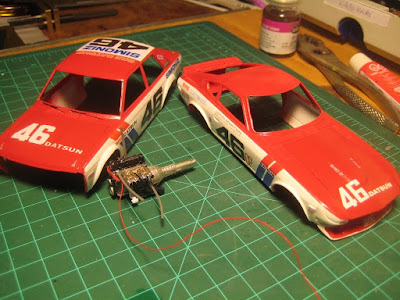
Continuing the theme of Getting Things Built, I put most of the decals on the 510.

The biggest problem is that the shade of red on the decals is just a bit orange compared to the Testor's red I used, but I am going to let this go. I probably won't bother respraying the 240Z, either.

The decals, being new, were a joy: quickly loosened, easily slid into place, no cracking or splitting, stayed put once I dried them. I think that from here on, I will scan decal sheets before starting to cut them up, so I can print a new sheet if an old one acts up.
Tomorrow is another day; Monday apparently, so I have to go to work. Stay tuned. Spring is around the corner, and with it the bicycle, so there may not be a lot of modeling left. We've had an extraordinarily mild winter which has reduced the number of days where you really can't go out unless you are some kind of nut, and at the current rate we'll be out of the freezing slop in no time.

The biggest problem is that the shade of red on the decals is just a bit orange compared to the Testor's red I used, but I am going to let this go. I probably won't bother respraying the 240Z, either.

The decals, being new, were a joy: quickly loosened, easily slid into place, no cracking or splitting, stayed put once I dried them. I think that from here on, I will scan decal sheets before starting to cut them up, so I can print a new sheet if an old one acts up.
Tomorrow is another day; Monday apparently, so I have to go to work. Stay tuned. Spring is around the corner, and with it the bicycle, so there may not be a lot of modeling left. We've had an extraordinarily mild winter which has reduced the number of days where you really can't go out unless you are some kind of nut, and at the current rate we'll be out of the freezing slop in no time.
Skyline update
So I decided to make a push to complete at least one of the ongoing projects. Get through a couple of these, I figured, and my completion rate could improve dramatically. So I tackled the remaining bits on the R34 Skyline: interior assembly, exterior details, final assembly.

It turned out pretty good, I think, although as noted before, the level of detail of this Tamiya kit is not as high as that of the 2000 GT-R, also from Tamiya. The under-hood shot shows this pretty clearly, even if you ignore the ignition wiring that I added to the 2000 GT-R.


This takes the completion ratio from 37.0% to 37.8% (51 models).
However I also made the mistake of ordering a few new items from a Japanese web site, increasing the total number of unstarted kits and thus dropping the completion rate to 36.4%. In particular I ordered another pair of Skylines.
The first one is the 1964 Prince Skyline 2000 GT. This 4-door sedan had a 2 litre 6, and the S54B version was equipped with three Webers, an overhead cam and a 5-speed box; it was apparently raced in Japan and came close to beating the Porsche 904. Styling, as with a lot of early '60s Japanese cars, is an acquired taste. Prince was in the process of being acquired by Nissan and the Prince brand disappeared from later cars, although Nissan retained the Skyline name. This Fujimi kit is curbside (no engine) but will make an interesting addition to the suite of Skylines. Box art shows it in a yucky two-tone brown and beige scheme: http://www.1999.co.jp/eng/10052823.
In 1973, Nissan released the successor to the 2000 GT-R shown above. Where the earlier car was quite attractive, this so-called C110 version had an enormous C-pillar that dominated the side view: http://www.1999.co.jp/eng/10312056. The Datsun 610 had similar oddball 'styling', although not as extreme. Again the engine was the attractive part, and this Fujimi kit appears to have full engine detail.
As with most things, you can find more information on these and other Skylines on Wikipedia, which is where I got most of this.
I will post details of these acquisitions, along with three other kits ordered at the same time, as they turn up in the mail. So New Completions: 1; New Acquisitions: 5. I am making progress but in the wrong direction.

It turned out pretty good, I think, although as noted before, the level of detail of this Tamiya kit is not as high as that of the 2000 GT-R, also from Tamiya. The under-hood shot shows this pretty clearly, even if you ignore the ignition wiring that I added to the 2000 GT-R.


This takes the completion ratio from 37.0% to 37.8% (51 models).
However I also made the mistake of ordering a few new items from a Japanese web site, increasing the total number of unstarted kits and thus dropping the completion rate to 36.4%. In particular I ordered another pair of Skylines.
The first one is the 1964 Prince Skyline 2000 GT. This 4-door sedan had a 2 litre 6, and the S54B version was equipped with three Webers, an overhead cam and a 5-speed box; it was apparently raced in Japan and came close to beating the Porsche 904. Styling, as with a lot of early '60s Japanese cars, is an acquired taste. Prince was in the process of being acquired by Nissan and the Prince brand disappeared from later cars, although Nissan retained the Skyline name. This Fujimi kit is curbside (no engine) but will make an interesting addition to the suite of Skylines. Box art shows it in a yucky two-tone brown and beige scheme: http://www.1999.co.jp/eng/10052823.
In 1973, Nissan released the successor to the 2000 GT-R shown above. Where the earlier car was quite attractive, this so-called C110 version had an enormous C-pillar that dominated the side view: http://www.1999.co.jp/eng/10312056. The Datsun 610 had similar oddball 'styling', although not as extreme. Again the engine was the attractive part, and this Fujimi kit appears to have full engine detail.
As with most things, you can find more information on these and other Skylines on Wikipedia, which is where I got most of this.
I will post details of these acquisitions, along with three other kits ordered at the same time, as they turn up in the mail. So New Completions: 1; New Acquisitions: 5. I am making progress but in the wrong direction.
Wednesday, February 10, 2016
A full selection of Porsche 917s
The 1969 917LH from Profil 24 turned up in the mail today. As a result I now have three kits of the 917, none started, the other two being a pair of 917Ks: the 1970 Wyer car in Gulf Oil colours that didn't win Le Mans (kit by Model Factory Hiro) and the 1971 Martini & Rossi car that did (Fujimi).

Why my obsession with the 917? It represents Porsche's deliberate move from dominating the 2-litre classes and leaving the overall wins to big blocks. With its 4.5 litre flat 12, the car was initially quite frightening, apparently, and a number of good drivers stayed away. The long tail (Lang Heck, or LH) was particularly unstable at speed, a problem solved by John Wyer when he hacked the back off to make the short (Kurz, or K) version. They were brutally fast and looked good, especially the K. And they dominated long-distance road racing until the advent of aero undertrays, with the later turbocharged Can-Am versions making 1000 hp. A real piece of racing history with a record and a mystique surpassed only by that of their true successor, the 956/962 series.

The Fujimi kit (in front, molded in gray) is a classic styrene kit that should be relatively straightforward to build. I have the detailed photo-etched sheet of accessories and the Historic Racing Miniatures engine to make things more interesting, but the challenges will still be relatively moderate.
The Profil 24 kit (in the back) is mostly resin, of much better quality than a typical Jimmy Flintstone effort but not quite up to Model Factory Hiro standards. (To be fair it is also a lot cheaper). The engine includes a fair bit of detail but the engine canopy doesn't open, or at least won't open without a lot of effort on my part, so there might not be much to see. And since the canopy opens leaving the long tail behind, this could be a real challenge.
The Model Factory Hiro kit is a monster. There are a million little spun-cast white metal bits, but the quality of the resin body is superb. Judging by the struggles I have had with their 908, this will be require a major investment in time and patience.

So recently I seem to be moving to completing (or at least tackling) multiple kits in a parallel theme: Mercedes 300 SL and 190 SL, BRE Datsuns, Nissan Skylines. The next step might be to clear some of these unfinished items out of the way and move on to a Porsche 917 blitz. Well, crawl, maybe, there is a lot of work here, and the 908 is still stalled. Finally I see Revell is reissuing their 914 this spring ...

Why my obsession with the 917? It represents Porsche's deliberate move from dominating the 2-litre classes and leaving the overall wins to big blocks. With its 4.5 litre flat 12, the car was initially quite frightening, apparently, and a number of good drivers stayed away. The long tail (Lang Heck, or LH) was particularly unstable at speed, a problem solved by John Wyer when he hacked the back off to make the short (Kurz, or K) version. They were brutally fast and looked good, especially the K. And they dominated long-distance road racing until the advent of aero undertrays, with the later turbocharged Can-Am versions making 1000 hp. A real piece of racing history with a record and a mystique surpassed only by that of their true successor, the 956/962 series.

The Fujimi kit (in front, molded in gray) is a classic styrene kit that should be relatively straightforward to build. I have the detailed photo-etched sheet of accessories and the Historic Racing Miniatures engine to make things more interesting, but the challenges will still be relatively moderate.
The Profil 24 kit (in the back) is mostly resin, of much better quality than a typical Jimmy Flintstone effort but not quite up to Model Factory Hiro standards. (To be fair it is also a lot cheaper). The engine includes a fair bit of detail but the engine canopy doesn't open, or at least won't open without a lot of effort on my part, so there might not be much to see. And since the canopy opens leaving the long tail behind, this could be a real challenge.
The Model Factory Hiro kit is a monster. There are a million little spun-cast white metal bits, but the quality of the resin body is superb. Judging by the struggles I have had with their 908, this will be require a major investment in time and patience.

So recently I seem to be moving to completing (or at least tackling) multiple kits in a parallel theme: Mercedes 300 SL and 190 SL, BRE Datsuns, Nissan Skylines. The next step might be to clear some of these unfinished items out of the way and move on to a Porsche 917 blitz. Well, crawl, maybe, there is a lot of work here, and the 908 is still stalled. Finally I see Revell is reissuing their 914 this spring ...
Subscribe to:
Posts (Atom)