Friday, December 4, 2020

Honda RC166: Overview and engine

In a fit of some kind I bought my first detailed motorcycle kit, Tamiya's excellent Honda RC166 in 1/12 scale.

The interest is due to the engine -- a 250 cc inline six (!) making 90 hp (!!) at 18,000 (!!!). Mike 'the Bike' Hailwood won the 1961 championship on this bike, by the simple expedient of winning every race he entered. Now why didn't I think of that? 

The engine is very well detailed in the kit, and if you think the bits in this 1/12 kit will be twice the size of the bits in a 1/24 kit, think again --- there are loads more bits. The engine block is made up of seven sets of finned sections, for instance. Loads of fun.


I also bought several aftermarket kits, including a photo-etched clutch assembly made up of alternating discs and plates. 


The engine, consisting of about 75 pieces, looks good and just needs a bit of tidying up. Stay tuned! But I might get back to the 156 first.

Ferrari 156: Paint

 Got paint on the various body parts, and while it looks good from far, it is far from good -- some errant dust specks got into it. (Tamiya pink primer and TS-49 Bight Red). So there will be some sanding, but no acetone or alcohol as I don't want to have to put in all the rivets all over again. Also got the interior done; the blue fabric for the seats may be a poor approximation. Waiting for paint to harden so I can get on to the sandpaper. Stay tuned!


Tuesday, December 1, 2020

Ferrari 156: lacing up four 72-spoke wire wheels

A few days required for this! First the hubs need to be drilled out to take the 0.40 mm (0.015") spokes; 288 holes all told. The Dremel is overkill, even with the variable speed drive provided by a sewing machine pedal, and leads to broken bits (three so far in the course of two wheels). So a lot gets done with the pin vise. Perfect for listening to the government's Fall Economic Update on the radio.


Then the spokes need to be fed in according to the instruction sheet. First, though, it is important to clear the workspace and ensure that only critical tools and supplies are close at hand, with everything else put away. One critical item (the 4X magnifier and desk lamp) is not shown. Working over a small tray also prevents bits bouncing off the bench and into the aether. 


 Once the hub is drilled and the hub and rim are mounted in the fixture, the sequence is:

1. Put a small bend in the end of the spoke
2. Insert spoke through rim. Dab with CA glue.
3. Poke into hole in hub, perhaps using pliers to assist.
4. Dab CA glue on spoke at rim.
5. Slide nipple over spoke and push through the rim until flush.
6. Repeat for the remaining 11 spokes on that row.
7. Trim excess spoke lengths with nipper.
8. Slather CA glue along inside of rim.
9. Have a sip of wine and take a breath.
10. Repeat for the 5 other rows. 
11. Slather 5-minute epoxy around the inside of the rim. It may be inelegant but it will never show once the tyre is mounted. 
 
 
The first wheel took about three hours, just to spoke it. Figure 5 hours total with the drilling and fiddling about, but subsequent ones should be faster.

OK, one wheel finished. 72 spokes, 72 nipples, rim and hub = 146 parts. Add the tire inflation valve and it will be 147. There are some mistakes (I'll let you find them), and I discovered potential future shortcuts which I will chalk up to experience in order to do better on the next three.


Next a rear wheel, which worked out a bit better and faster.


Update, 2020-12-02: All four wheels are done and it sits nice and square.The last two were definitely done faster than the first two, and have fewer flaws.


It's beginning to look like a car. Stay tuned! 

Saturday, November 28, 2020

Ferrari 156 Sharknose: Chassis and suspension complete

I got brave and assembled the rear cradle around the engine, then the front chassis tubes were glued to the cockpit chassis, and finally the rear cradle attached to the cockpit.


The cockpit chassis section, which is made of large stiff flat pieces, was used to ensure the engine cradle stayed straight while the epoxy set.

Then the forward chassis section, which takes the front suspension, was assembled. The instructions had the entire front end, including suspension, radiator and various other gubbins, all assembled before fitting to the cockpit section, but that struck me as extremely foolish -- after a lot of gluing and fiddling, the probability that it wouldn't all line up was high.

 
Once the forward chassis was attached to the cockpit, I went and attached the engine cradle and drivetrain as well.


Some time ago I purchased a temperature-controlled soldering iron for this purpose, but chickened out and used 5 minute epoxy instead. No risk of melting priceless white metal bits into a little puddle, but it was still a stressful 5 minutes! But it's all relatively straight and it looks like it will sit pretty much square on its four wheels.

.

At this point I used machinist's blocks to assemble the front suspension in such a way that even if the chassis is a bit crooked, the wheels will all sit flat. 

Stay tuned! This basking shark is moving right along.


Thursday, November 26, 2020

Ferrari 156 Sharknose: Engine compartment and rear suspension complete

Boy does 1/12 scale allow for a lot of detail. I added starter motor wiring and the low-tension side of the coils, but the kit included high tension wiring, fuel lines, throttle linkage, brake lines, coolant overflow and transmission breathers (both of which just dump onto the pavement behind the car, much to the surprise of the guy following!). The photos speak for themselves. 


Stay tuned! There is lots more to come. 

Monday, November 23, 2020

Ferrari 156 Sharknose: Getting back into the groove

This 1/12 scale kit is,well, BIG. And detailed. 

Last update was August 2019 (click here), where I went to great lengths to ensure the chassis would all be straight. The pause was to decide whether to solder or glue the chassis tubes. Solder requires a temperature controlled iron and low-temperature solder; I acquired both and got one or two pieces to stick but mostly it didn't work; I suspect I was afraid to put in enough heat. 

So I'll be going for the 5-minute epoxy where strength is critical. Here is the central cockpit all glued up and ready to go.

Transmission assembly includes the inboard brakes and the clutch and associated bits. This is all needed prior to assembling the rear chassis assembly, which will lean partly on the completed central chassis assembly for keeping it all straight.


With the engine and transmission assembled and glued/screwed to the lower portion of the rear chassis tubes, next step is to finalise the upper portion of the chassis as in the second photo. But first I had to drill out a load of holes for screws and rivets holding A-arms, uprights, shocks and whatnot. Then it will all need to be painted. Once ready for assembly, I'll use 5 minute epoxy which means I'll have to work fast to get it all lined up before the glue seizes up. Some jigs may need to be built or improvised. Stay tuned!

Saturday, November 21, 2020

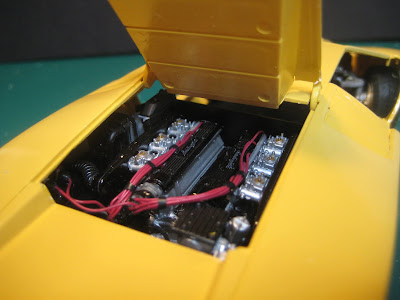
Lamborghini Countach: Protoype bodywork and chassis

What a fiddly kit! Getting the chassis to sit square on its 4 wheels will be a challenge. 

But the body mods to reproduce the LP500 prototype have turned out reasonably well. 


I did not cut out the vents in the engine lid, as seen in several period photos of the prototype; but I did manage to put in radiator mesh from Detail Master. The "periscope" rear view mirror has also been cut into the roof.


Final assembly looms large. I've slowed down since finishing the Toyota 2000 GT about a month ago; so I am hoping to finish this before the end of 2020. Stay tuned!